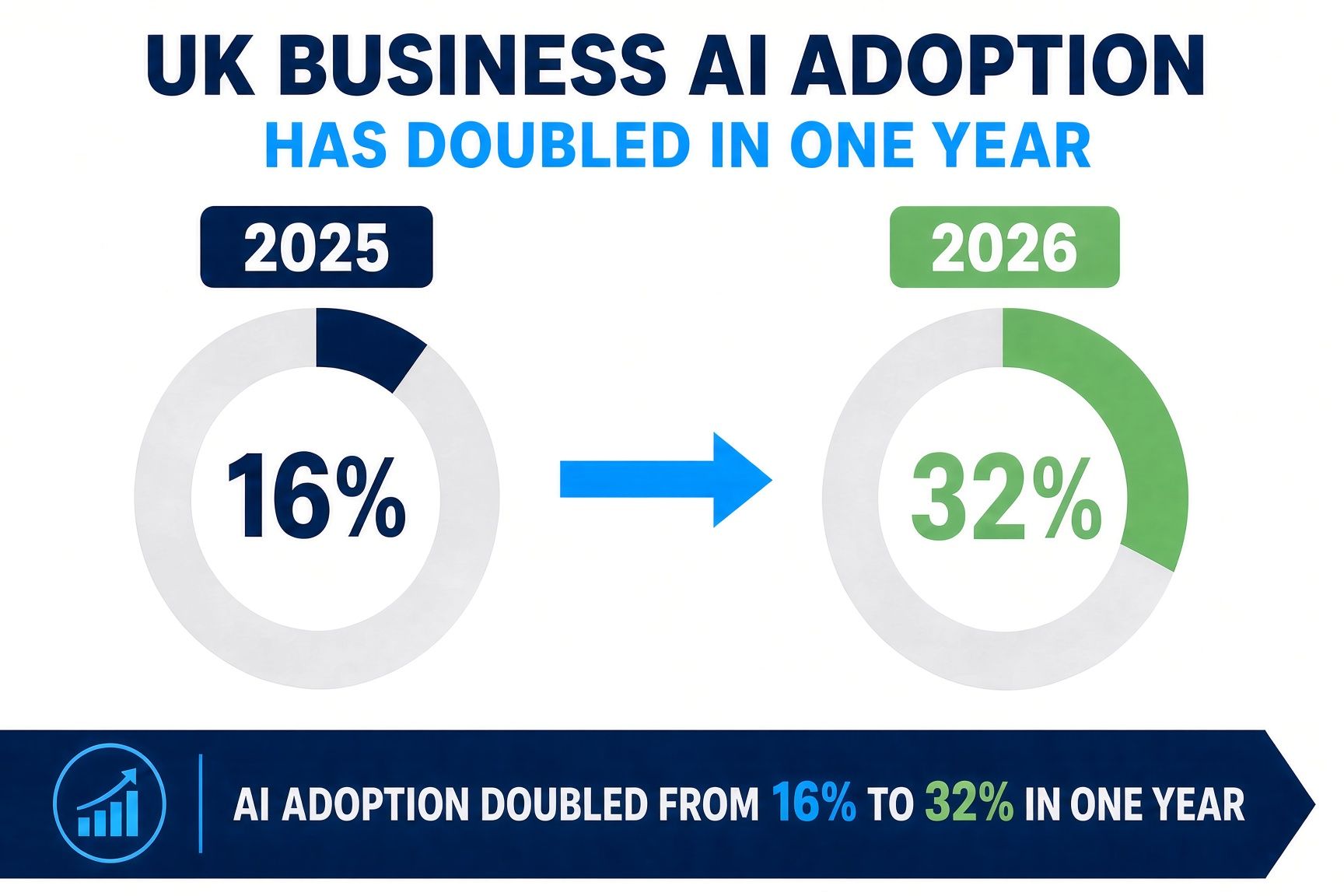

The number of UK businesses using or piloting artificial intelligence (AI) rose from 16% in 2025 to 32% in 2026, according to a UK Government commissioned survey. The findings suggest that AI adoption is growing, but many businesses still need help developing the skills and confidence to use it effectively.
The survey covered 3,503 private-sector businesses across the UK with at least five employees. It does not represent every business: sole traders, smaller employers and some sectors were outside its scope. The research was published on 29 October 2026. Source: AI Adoption Survey 2026 executive summary.
What does the survey tell us about AI adoption?
The research found that 32% of surveyed businesses were using or piloting AI in 2026, compared with 16% in 2025.
The survey also found that skills and knowledge remain a challenge. Limitations in this area affected 67% of businesses already using AI and 78% of those planning to adopt it.
That gap between interest and practical knowledge is something I regularly see when speaking to businesses. Many people have tried an AI tool, but are unsure where it fits into their work, how to check its output or what information is safe to share.
Where are businesses using AI?
Among businesses using or planning to use AI, the survey identified administration, marketing and IT as common areas for current or planned use. The figures were 81% for administration, 71% for marketing and 66% for IT.
These figures include planned as well as current use. They should not be read as the percentage of all UK businesses already using AI in each area. Source: full research report.
For a small business, practical starting points might include preparing a first draft of a customer email, summarising a meeting, exploring ideas for a marketing plan or identifying repetitive administrative tasks. The right use depends on the business and the information involved.
The big question: Is AI improving productivity?
Half of the businesses that had adopted AI reported increased employee productivity. Around a quarter, 24%, reported lower operating costs.
These are businesses’ own reported experiences. The findings do not mean that productivity rose by 50%, or that AI caused the improvement in every case. Nor do they guarantee the same result for another business.
In my experience, the best place to start is with a specific task rather than a particular tool. Look at how the task is currently completed, agree what a useful improvement would look like, and review whether the AI-supported approach actually helps.
What does the research say about AI adoption in Scotland?
The full report found that 69% of surveyed businesses in Scotland neither used nor planned to use AI. The Scotland sample included 172 businesses. The researchers reported no statistically significant regional differences in adoption in 2026, so the findings do not establish that Scotland is falling behind other UK regions.
For Scottish businesses, the message is not that everyone needs to adopt AI immediately. It is that there is an opportunity to explore it in a considered way, starting with the needs of the business and the people doing the work.
How can a business get started with AI?
A practical first step is to choose one suitable, low-risk task and test whether AI can help. For example:
1. Identify a repeated task. Choose something that takes time and has a clear outcome.
2. Agree what information can be used. Avoid entering confidential or personal information into a tool unless your organisation has approved that use.
3. Test and check the result. AI can make mistakes, so a person should review facts, tone and suitability before anything is used or shared.
4. Measure what changed. Consider the time spent checking as well as the time saved producing the first draft.
5. Share what works. Give colleagues guidance and training so good practice is consistent.
Sources: UK Government executive summary and full AI Adoption Survey 2026 report.